Story Sacks Guidance and Tips
Make a story sack and share it
Story sacks are a wonderful way to make a story sharing session truly immersive and engaging. Reading aloud combines with storytelling and role play. The idea is to gather a simple collection of props that can be used to develop the story in imaginative ways, making it an immersive experience for the audience.
If you are thinking of a way to enter our national competition, why not make a story sack and share it?
First of all, you need to choose a story – one that you love and that will appeal to the particular interests of your audience – and invest in a copy of it. Our 2026 National Share-a-Story Month booklist is bursting with read-aloud favourites; or you could turn for inspiration to the Children’s Book Award.
Next, you need to put together some items that will help with the story telling and encourage children to think about it more carefully.
To give you some inspiration, Shirley Imlach, from Ipswich Children’s Book Group has kindly shared ‘recipes’ from story sacks she has made in the past. She writes, ‘of course some of these were for special projects and therefore took a while to put together, but they would not need to be so complex if people were just sharing the story.’ This last point is important. The focus should be on the shared storytelling, not the perfection of your props.
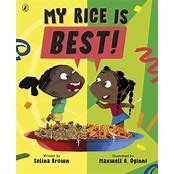
Think about using things from charity shops or the recycling bin. An old bowl, a few spoons and a clean empty rice pudding pot, for example, would all work to accompany My Rice is Best (one on the NSSM booklist).
Here are some fuller ideas from Shirley with photographs and notes.
The Story Blanket
by Ferida Wolff, Harriet May Savitz and Elena Odriozola, published by Andersen Press
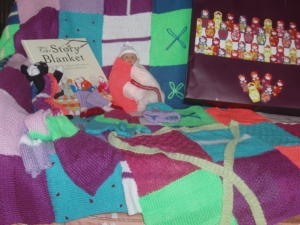
This story about generosity really sums up the spirit of National Share-a-Story Month. Shirley says for this one ‘Mum knitted all the items for me and Heather used it in school saying how much the children loved engaging with them while listening to the story.’ Just using some wool and knitted items would still work beautifully.
Six Dinner Sid
by Inga Moore, published by Hodder Children’s Books
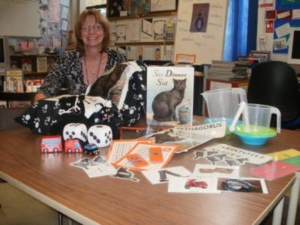
This classic story has many hallmarks of a great read aloud book: repetition, humour and a loveable main character. Sid’s foibles are relatable: he just loves to eat. Shirley made this for the Hospital School Room so, as you can see, it included some maths resources. It could easily be simplified to include just a toy cat, play food and bowls.
Edgar the Sausage Inspector
by Jan Fearnley, published by Nosy Crow
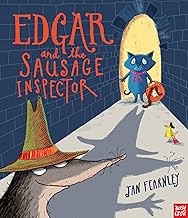
As Shirley says, ‘a great one for reading out loud’ and a Children’s Book Award favourite too. Unfortunately it is currently unavailable new but, in case you can find a copy then here is Shirley’s story sack recipe: ‘I included Edgar’s trilby hat, a magnifying glass, a notebook and pen, some sausages made from old tights and play food.’ She was still using it last year to read to Reception for World Book Day.
Shark in the Park
by Nick Sharratt, published by Corgi Children’s
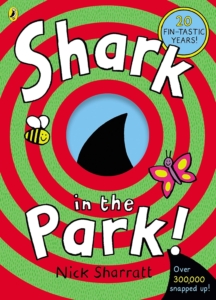
The rhymes and repetition make this perfect for reading aloud. Bring it to life with a toy telescope, recommends Shirley. She adds, ‘I think I included a non-fiction book on sharks too.’
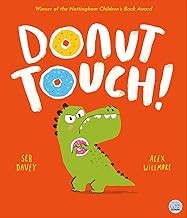
For one final idea, Shirley suggests Donut Touch! by Seb Davey and Alex Willmore, published by Gemini Children’s. It’s a hilarious, read aloud story from this year’s National Share-a-Story Month list. Gather together some plastic doughnuts and a soft dinosaur and join in the fun!