
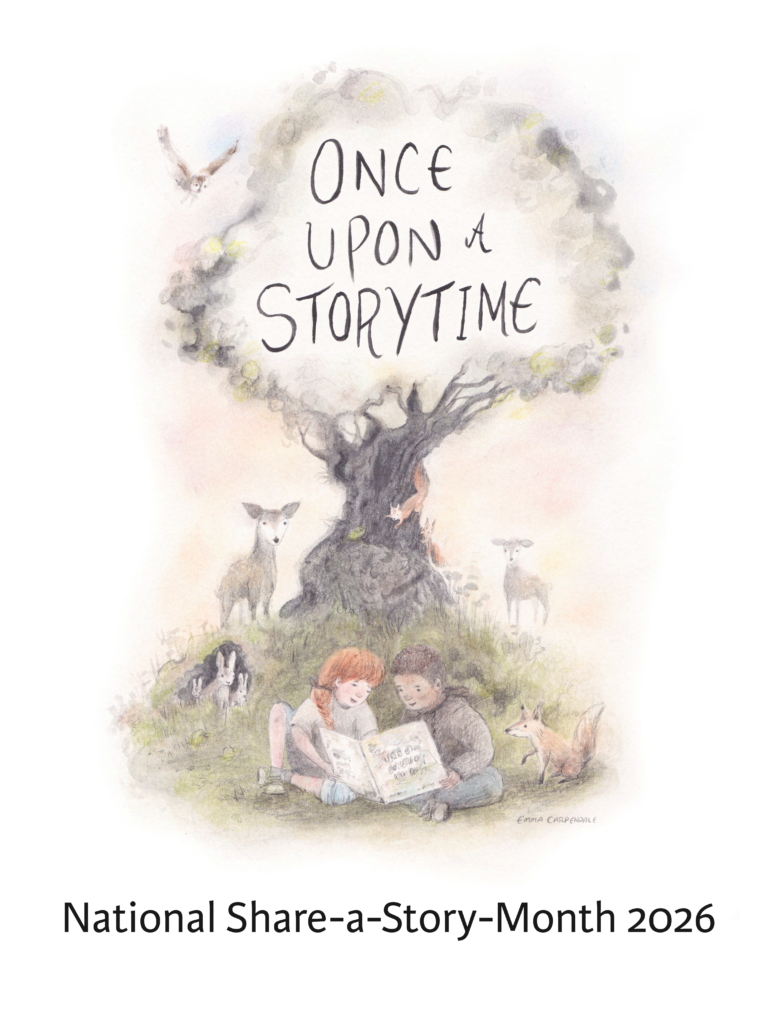
What Makes a Great Read Aloud? by Louisa Farrow
What Makes a Great Read Aloud?
Choosing the National Share-a-Story Month booklist
There is something magical about being read to and sharing a story with a roomful of others. At ten, I had been reading to myself for years. Even so, when the headteacher of my primary school, Miss Welch, came in to read Linnets and Valerians by Elizabeth Goudge (now renamed The Runaways) I wasn’t just happy to listen, I was spellbound. Miss Welch was old-fashioned, eccentric, a little bit scary, but none of that mattered. She was obviously enjoying it too.
As I sat down to compile this year’s National Share-A-Story Month book list, I had to think carefully. What exactly is it that makes a great read aloud? There was Miss Welch with the first criterion: the reader’s own enthusiasm. It will be infectious if we are revelling in the story ourselves.
So how was I to find a way to identify books that would reflect a wide range of tastes, not just my own? There had to be room for choice, because not all books suit all people. Help was at hand in the form of our many local members who have generously shared their ideas and in past voting records from the Children’s Book Award. Many on this list were CBA favourites.
How, though, should I strike a balance between old favourites and contemporary gems? Miss Welch read the same book every year – if you find a winner, why change? But there is such richness in contemporary children’s publishing it felt right to celebrate it. On reflection, I decided this booklist would be most useful if it were mostly to focus on more recent titles. I hope our readers will appreciate the logic, even as they mourn some of the inevitable omissions.
The list was still a bit too long. What exactly was it that made books good to read aloud, other than the enjoyment of the reader?
Great read-alouds use elastic text that allows you to change pace and tone in the narrative too. Variety of sentence types, resonant phrases and lyrical language can all support the reader and help to draw the listener in. There is a special section for verse novels because they do this so well.
Well-written direct speech that captures the rhythms of conversation is another friend of the reader aloud. ‘Doing’ different voices can really bring a reading to life for the listener while establishing characters. Badgers are Go! by Susannah Lloyd and Nici Gregory is a good example. So too is Matt Goodfellow’s ‘The Final Year’.
Repetition, especially in books for younger children, can help the listener compensate for any lapses of attention and encourage participation. That’s why a title like the Princess and the Greedy Pea captured attention in the Children’s Book Award. It’s why I included Mama’s Favourite Wonton Soup by Wai Mei Wong and Xin Yue Zhu.
The most beautiful writing won’t save a poor story. Both reader and listener will value a tight plot and the opportunity to build excitement and suspense. Frequent cliffhangers will leave the audience begging for more. Anya and the Light Beyond the Ocean by Amelia Giudici, Safiyyah’s War by Hiba Noor Khan, or Natasha Farrant’s The Secret of Golden Island are great examples.
Folk tales, myths and legends have been tested and refined through centuries of oral storytelling, so it’s no surprise to see books inspired by traditional story telling. The House with Chicken Legs Runs Away; Rumaysa; Anansi and the Golden Pot; George and the Dragon and Animal Tales from India are just a few that draw directly on that richness.
Sadly, I haven’t the space to mention all the books from the list. I hope you will explore it yourself and that it may inspire you to try out something new. And I hope it may help a new generation of out-loud readers to find their own favourites because the relish of the reader is paramount.
Many thanks to:
– All the Children’s Book Group members who shared their favourite read alouds
– Jane Etheridge for compiling and sharing voting data from previous CBA Awards and for proof-reading
– Jasmine Brown and Emma Carpendale for help with designing the list
